Yamamoto
The Wind-Up Bird ChronicleYamamoto, introduced as a civilian hired by the army, is in fact the unquestioned leader of a covert border mission. His authority over Lieutenant Mamiya and his refusal to surrender a document mark him as a disciplined operative; his capture and death leave Mamiya with a memory that later helps destroy his faith in political ideals.
Identity and Mission
In late April 1938, a senior General Staff officer introduces Yamamoto to Mamiya, describing him as a civilian investigator of Mongolian life and customs in Manchukuo. Yamamoto is to travel near the Outer Mongolian border, accompanied by an armed escort. Mamiya immediately doubts the official explanation: Yamamoto’s bearing, speech, and eyes suggest a professional soldier concealing his identity, and the assignment feels ominous.
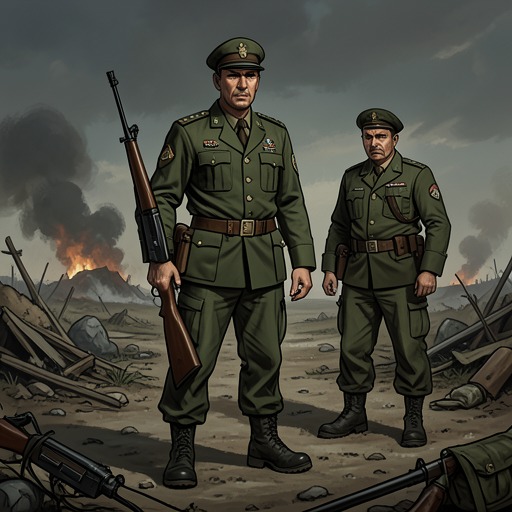
The escort consists of only three men: Mamiya, the inexperienced officer placed in nominal command; Hamano, a battle-tested sergeant; and Honda, a quiet corporal newly arrived from Japan. Mamiya’s own role is to survey the western Manchukuo border near the Khalkha River and improve military maps. The maps are crude, yet accurate terrain information could prove crucial if the unresolved border situation erupted into war. The mission therefore joins topographic work to military intelligence, while keeping its true purpose obscure.
Command and the Border Journey
After five days of preparation, the group travels by train from Hsin-ching to Hailar, then by truck to a border observation post and onward on horseback. Yamamoto makes the decisions and issues instructions. Although military regulations require Mamiya to act as commander because Yamamoto is officially a civilian, the group recognizes Yamamoto as the actual authority; Mamiya has also been specifically ordered to obey him without question.
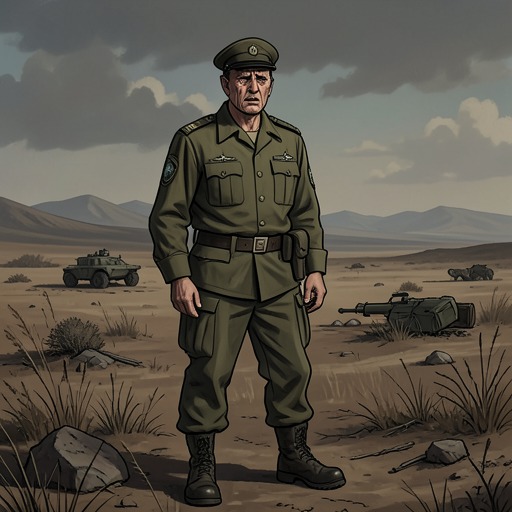
The assignment’s practical demands underscore the precariousness of the border. The group carries only light arms, and the terrain offers few reliable landmarks against which Mamiya can check his maps. As they follow the swollen Khalkha River south, they record topographic details, while Yamamoto demonstrates unusually precise knowledge of the region. His silence outside those technical exchanges and his apparent familiarity with the land reinforce Mamiya’s sense that the official account explains little about him.
The Document and Its Protection
At a critical point, Yamamoto explains that his saddlebag contains a document intended for headquarters. Delivery is important, but preventing its capture is more important: if delivery becomes impossible, the document must be destroyed rather than allowed to reach the enemy. The order gives the otherwise shadowy expedition a concrete priority and makes clear that the group’s obligations extend beyond ordinary mapping work.
Yamamoto also instructs Mamiya to shoot him if circumstances become dire, specifying that the shot must be fatal. His injured arm may prevent him from carrying out that instruction himself. The request places responsibility for both the document and Yamamoto’s fate on Mamiya, and shows the severity of the secrecy surrounding the mission. The surviving account establishes the order and its stakes, but does not establish what ultimately happens to the document.
Capture and Death
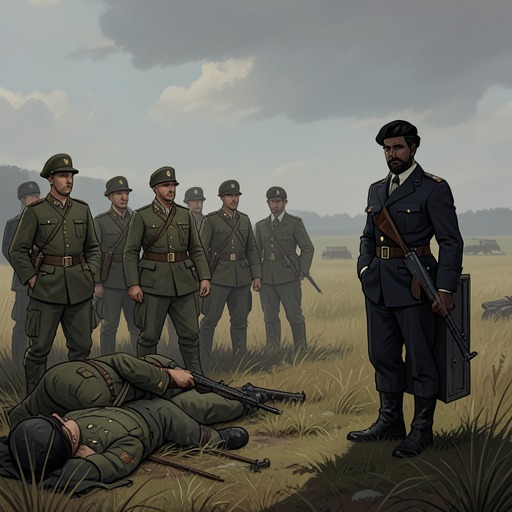
Yamamoto is captured by the Russian officer and Mongolian soldiers. They bind him and prepare to kill him, using the prospect of a prolonged death to pressure him into talking. Yamamoto says nothing. The account presents his silence as a refusal to betray what he knows, even as his captors attempt to make disclosure the means of ending his suffering.
Mamiya is forced to witness Yamamoto’s death. Unable to bear watching, he closes his eyes, but a soldier strikes him until he opens them; the attack cannot spare him from hearing what is happening. Yamamoto’s suffering eventually silences him. The episode is narrated through Mamiya’s recollection, whose persistence is evident in the memory that the captor’s smile continues to appear in his dreams. Rather than treating the death as a distant battlefield statistic, the narrative makes it a lasting personal witness.
Aftermath and Significance
Years later, Mamiya recalls Yamamoto alongside the atrocities and institutional violence he has seen under Japanese and Soviet rule. He remembers the deliberate killing of Chinese laborers during construction of a secret base near Hailar, and connects those crimes with the torture he witnessed and his own ordeal in a Mongolian well. These experiences make it impossible for him to trust political systems merely because they claim to serve an ideal.
Yamamoto’s fate thus belongs to a broader account of war shaped by secrecy, coercive command, and the use of human beings as expendable instruments. The border mission depends on incomplete maps and concealed purposes; the later wars and prison-camp system reveal the human cost hidden behind institutional priorities. For Mamiya, the death is not simply the end of a mission’s leader: it becomes part of the evidence from which he concludes that ideology cannot redeem the people and systems responsible for violence.